Pure envelope check for the MTP speculative path (gh#108). More...
#include <string>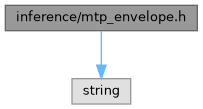
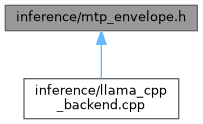
Go to the source code of this file.
Namespaces | |
| namespace | entropic |
| Activate model on GPU (WARM → ACTIVE). | |
Functions | |
| std::string | entropic::mtp_unsupported_reason (float temperature, bool has_grammar, bool streaming) |
| Reason MTP cannot run for a request, or "" when the envelope is safe. | |
| bool | entropic::looks_like_mtp_head (int n_layer) |
| True when the model's layer count is consistent with an MTP head GGUF. | |
| std::string | entropic::mtp_head_classical_path_error (int n_layer) |
| Actionable error message for gh#107: MTP head on classical path. | |
Detailed Description
Pure envelope check for the MTP speculative path (gh#108).
MTP (multi-token-prediction) decode is correct in the greedy (temperature=0), unconstrained (no grammar), non-streaming envelope. Outside it, the engine must FAIL LOUDLY so the consumer corrects the config — never silently fall back to plain decode (which masks that MTP never ran). This predicate is a pure function so the decision is CPU-unit-testable independent of any GPU/model; the backend wiring that consults it is verified by model tests.
gh#108 (v2.9.2): TOOLS are NOT a guard. MTP is lossless at temp=0, gemma4 tool-calling is parsed post-hoc (not sampler-grammar-constrained), so MTP + staged tools produces the same tool call as plain decode. The earlier "tools" guard was over-broad; the real gap was stop-handling, now fixed (MTP honors effective_stop). This makes MTP reachable through the agent loop.
gh#108 (v2.9.3): the flash_attn guard is dropped. It existed because the gemma4-assistant head (GQA-2 + head_dim-512) hit an unsupported MMA specialization in ggml_cuda_flash_attn_ext and GGML_ABORTed. Upstream llama.cpp #25148 ("CUDA: fix Gemma E4B MTP FlashAttention", merged 2026-06-30) restores that specialization; the extern/llama.cpp pin was bumped past it, so MTP + flash_attn is now safe (and unblocks quantized KV, which requires flash).
gh#108 (v2.9.4): the temperature>0 guard is dropped. It assumed the accept step needed rejection sampling to be lossless at temperature>0 — but common_speculative_impl_draft_mtp::draft() (extern/llama.cpp/common/ speculative.cpp) always proposes cur_p->data[0].id, the argmax of the (top-k=10-filtered) draft distribution, and never the stochastically selected candidate — this holds regardless of backend_sampling, since draft() never reads cur_p->selected. The draft proposal is therefore a deterministic point mass at every temperature. For a point-mass proposal q(m)=1, the general Leviathan/Chen rejection-sampling accept rule (accept-prob min(1, p_target(t)/p_draft(t)), resample residual on reject) collapses algebraically to exactly what entropic's accept step already does: draw one real sample s ~ p_target (common_sampler_sample_and_accept_n, extern/llama.cpp/common/sampling.cpp, draws through the target's full real filter chain), accept iff s == draft[i], else emit s as the correction. This is lossless at any temperature, not just temperature=0 — provided the draft proposal stays a point mass. If a future extern/llama.cpp pin bump changes draft() to honor cur_p->selected instead of data[0], this proof no longer holds and the guard must be reinstated; the statistical distribution test in test_gh108_mtp_guards.cpp is the regression tripwire for that.
gh#108 (v2.10.0): the grammar guard is dropped. It existed because to_common_sampling did not propagate params.grammar to the MTP sampler chain, so GBNF constraints were silently ignored under speculative.mtp. Fixed by propagating cps.grammar in to_common_sampling (llama_cpp_backend.cpp). The loader static check rejecting mtp+grammar at parse time is also removed.
gh#108 (v2.10.0): the streaming guard is dropped. It existed because strip_thinking_channels is a post-buffer operation — live tokens fired through on_token would expose raw thinking channel markers. Fixed by wrapping on_token with StreamThinkFilter in generate_streaming (orchestrator.cpp) so incremental stripping is correct; apply_adapter_parse handles the buffered result.content on return. MTP streaming is now fully supported.
WHAT "LOSSLESS" DOES NOT MEAN (v2.12.2). Everything above is a claim about the DISTRIBUTION: the accept step emits a token drawn through the target's own full filter chain, so MTP output is distributed exactly as plain decode output is. It is NOT a claim that a given MTP run reproduces a given plain run token-for-token, and reading it that way produces a false bug report.
A consumer measured 18 turns against 17 for the same workload at temperature 0, took it for a losslessness violation, and came within one step of filing it. Two reasons it is not:
- Speculation verifies a BATCH of n_draft+1 positions where plain decode takes one at a time. Batched GPU matmuls reduce in a different order, so the two paths are not bitwise identical even when algebraically equivalent, and one near-tie argmax resolving the other way diverges every token after it.
- More decisively, plain decode on this hardware is not reproducible against ITSELF — two identical cold prefills diverge run-to-run (see tests/model/gh87_verify_helpers.h, and the reason model tests here never assert exact output equality). So a divergence between an MTP arm and a plain arm is not evidence about MTP at all; it is the baseline.
A genuine bitwise losslessness test would need deterministic kernels, which is not something a consumer — or this suite — can arrange. The empirical distribution test in test_gh108_mtp_guards.cpp is the statistical stand-in, and it is what would actually catch a pin bump breaking the point-mass assumption above.
- Version
- 2.12.2
Definition in file mtp_envelope.h.