Loading...
Searching...
No Matches
response_parse.h File Reference
One template-first / adapter-second parse rule for raw model output. More...
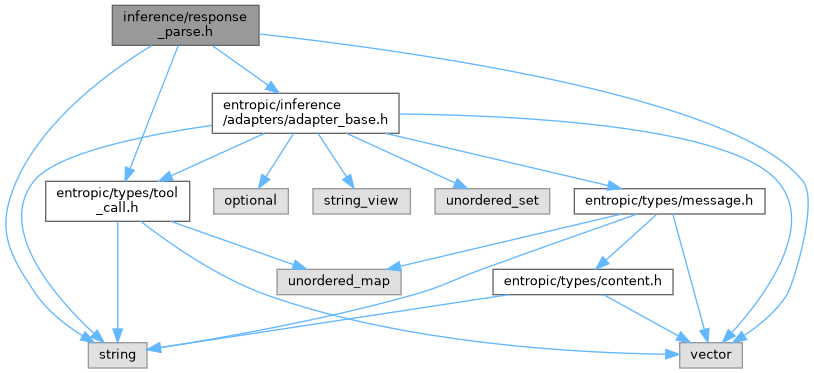
#include <entropic/inference/adapters/adapter_base.h>#include <entropic/types/tool_call.h>#include <string>#include <vector>
Include dependency graph for response_parse.h:
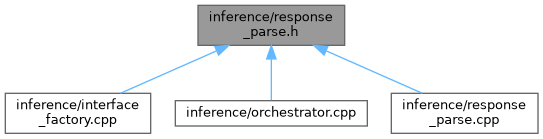
This graph shows which files directly or indirectly include this file:
Go to the source code of this file.
Classes | |
| struct | entropic::ParsedModelResponse |
| Content and tool calls extracted from one raw emission. More... | |
Namespaces | |
| namespace | entropic |
| Activate model on GPU (WARM → ACTIVE). | |
Functions | |
| bool | entropic::calls_satisfy_schema (const std::vector< ToolCall > &calls, const std::string &tools_json) |
| Check that every call's declared required parameters are present. | |
| ParsedModelResponse | entropic::parse_model_response (LlamaCppBackend *llama, ChatAdapter *adapter, const std::string &raw) |
| Parse a raw emission: template first, adapter second. | |
Detailed Description
One template-first / adapter-second parse rule for raw model output.
- Why this exists (gh#108, v2.10.3)
- The same branch was written twice —
orchestrator.cpp(buffered generate result) andinterface_factory.cpp(agent-loop tool parse) — each choosing between llama.cpp'scommon_chatparser and the engine's ChatAdapter. The duplication is how a fix reached one path and not the other.
It also encoded the wrong relationship. common_chat_parse_reliable() is parse_params_valid_ && format == PEG_GEMMA4: it exists to say *"this
captured format is multi-parameter safe"*, and thinking-block removal got bolted onto it. So reasoning stripping only happened for gemma4, and only when a TOOLED render had captured a parser arena — a toolless generate fell to the adapter branch with no channel handling at all.
The rule here separates the two concerns, because they compose differently:
- Content cleanup composes. Run the template parse when an arena exists, then ALWAYS run the adapter's strip over the result. Stripping is idempotent — if the template already removed reasoning, the second pass is a no-op — so no decision logic is needed and no path can be missed.
- Tool-call extraction does not compose. Two call lists cannot be merged safely, so it is genuinely either/or. The template wins when its result is trustworthy; the adapter is the fallback.
- Why the tool-call fallback needs an a-posteriori check
common_chat's PEG autoparser extracts only the FIRST<parameter=>of a multi-parameter call (gh#87 Phase D) — and it does so silently, returning a well-formed ToolCall with arguments missing. A try/catch fallback would never fire. So the template result is validated against the staged tool schema, and a call missing declaredrequiredparameters routes to the adapter's hand-rolled parser (xml_parameter_parser, which also tolerates the gh#79</NAME>close tag). Without this, moving Qwen/Nemotron onto the template path would quietly drop arguments.
- Version
- 2.10.3
Definition in file response_parse.h.