Implementation of the tool-result content classifiers (#44). More...
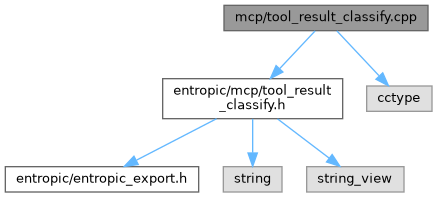
Go to the source code of this file.
Namespaces | |
| namespace | entropic |
| Activate model on GPU (WARM → ACTIVE). | |
Functions | |
| ENTROPIC_EXPORT bool | entropic::mcp::is_effectively_empty (std::string_view s) |
True if s is empty or contains only ASCII whitespace. | |
| bool | entropic::mcp::starts_with_json_error (std::string_view trimmed) |
| True if input begins with a JSON top-level "error" key. | |
| ENTROPIC_EXPORT void | entropic::mcp::truncate_to_cap (std::string &content, int cap) |
| Truncate tool-result content in place when it exceeds cap. | |
| ENTROPIC_EXPORT bool | entropic::mcp::looks_like_tool_error (std::string_view content) |
| Heuristic: the rendered tool-result text reads as an error. | |
Detailed Description
Implementation of the tool-result content classifiers (#44).
- Version
- 2.1.0
Definition in file tool_result_classify.cpp.
Function Documentation
◆ is_effectively_empty()
| bool entropic::mcp::is_effectively_empty | ( | std::string_view | s | ) |
True if s is empty or contains only ASCII whitespace.
True if input is empty or contains only ASCII whitespace.
@utility
- Version
- 2.1.0
Byte-level emptiness: whitespace-only content counts as empty, so a tool that "succeeded" with nothing to say is classified ok_empty rather than ok.
- Parameters
-
s Tool result content (already truncated to the cap).
- Returns
- true for an empty or whitespace-only view, false as soon as any non-space byte is seen. @req REQ-MCP-019
- Version
- 2.1.0
Definition at line 61 of file tool_result_classify.cpp.
◆ looks_like_tool_error()
| bool entropic::mcp::looks_like_tool_error | ( | std::string_view | content | ) |
Heuristic: the rendered tool-result text reads as an error.
Heuristic match for an error-shaped tool result string.
Recognises (case-insensitively, after stripping leading whitespace):
Error: …/ERROR …[error] …- top-level
{ "error": … }
Negative case: "… error somewhere in the middle" is NOT classified as error — only leading-token shapes count.
@utility
- Version
- 2.1.0
Anchored at the first non-space byte, so the word "error" appearing mid-string does NOT classify the result as an error.
- Parameters
-
content Tool result content (already truncated to the cap).
- Returns
- true when the content leads with
Error/ERROR,[error], or a top-level{"error": ...}object; false otherwise. @req REQ-MCP-019
- Version
- 2.1.0
Definition at line 127 of file tool_result_classify.cpp.
◆ starts_with_json_error()
|
inline |
True if input begins with a JSON top-level "error" key.
Deliberately shallow — a leading '{' plus an "error" key inside the first 32 bytes — so a nested "error" deep in a large payload does not reclassify an otherwise successful result.
- Parameters
-
trimmed Left-trimmed tool result content.
- Returns
- true for a
{"error": ...}-shaped object, false otherwise. @req REQ-MCP-019
- Version
- 2.1.0
Definition at line 80 of file tool_result_classify.cpp.
◆ truncate_to_cap()
| void entropic::mcp::truncate_to_cap | ( | std::string & | content, |
| int | cap | ||
| ) |
Truncate tool-result content in place when it exceeds cap.
Truncate content in place when it exceeds the byte cap.
Demo ask #6 (v2.1.0). When cap is 0, no-op. When content size exceeds cap, the content is shrunk to cap - tail.size() bytes followed by a trailing \\n[... truncated, N more bytes] marker so downstream consumers (the model, classification, the duplicate cache) see the bounded form with a clear signal that bytes were lost. Final size is ≤ cap.
- Parameters
-
content Mutable string; truncated in place when exceeded. cap Maximum byte length. 0 disables. @utility
- Version
- 2.1.1-rc1
Applied at the inbound boundary, BEFORE classification, duplicate recording and history, so the model, the classifier and the dedup cache all see the same bounded form and can tell bytes were lost.
- Parameters
-
content Result content, truncated in place. cap Maximum bytes; a cap of 0 (or negative) disables truncation.
- Returns
- Nothing — content is left untouched when it is already within cap, otherwise resized to at most
capbytes ending in a[... truncated, N more bytes]marker. @req REQ-MCP-019
- Version
- 2.1.1-rc1
Definition at line 102 of file tool_result_classify.cpp.